


































Request a demo

34 one-page answers

Frequently Asked Questions (FAQ’s)

Capital as a Service (CaaS™) and funded vendor managed inventory (VMI) for CFOs, partners, procurement and technology leaders. Each answer fits one page and answers a question buyers, partners and executives actually ask.

1TCC is a VMI and inventory ownership provider. It acquires, owns, holds and manages inventory on behalf of enterprise customers. It is not a bank, lender or financier.

  1. A. CFO and corporate finance 10 questions
  2. B. Capital partners, banks and insurers 10 questions
  3. C. Procurement and supply chain 8 questions
  4. D. Technology and AI 6 questions

A. CFO and corporate finance

FAQ’sA. CFO and corporate finance

1 of 34

How to Free Up Cash Tied Up in Inventory

Audience: CFOs

A finance director in a glass-walled mezzanine office looking down at racked pallets of manufactured parts

Inventory is often one of the largest working capital lines, and cash sitting in stock is not available for growth, R&D, acquisitions or debt reduction. The usual response is to cut stock, which risks stockouts and line stoppages.

Practical levers

  • Separate strategic inventory from excess and slow-moving stock.
  • Rationalize SKUs and safety stock using real demand data.
  • Move suitable, stable-demand items into a supplier-held or VMI model.
  • Align purchasing with consumption rather than batch convenience.

Next step: ask 1TCC for an inventory assessment to identify which categories suit a funded VMI model.

Email 1TCC about this


FAQ’sA. CFO and corporate finance

2 of 34

The Hidden Cost of Inventory on Corporate Balance Sheets

Audience: CFOs, CEOs

Dusty, slow-moving cartons on tall warehouse racking, a pallet jack parked in the quiet aisle

The purchase price of inventory is only the start. Carrying it costs money every day it sits in a warehouse.

Costs that rarely show up on one line

  • Cost of capital on the cash invested in stock.
  • Storage, handling, insurance and shrinkage.
  • Obsolescence and write-down risk, especially in fast-changing technology and healthcare products.
  • Management time spent on planning, counting and expediting.
  • Opportunity cost: the return the same capital could earn elsewhere.

Many finance teams track inventory value closely but not its full carrying cost, so the true burden is understated and the case for change is weak.

Next step: use 1TCC's carrying-cost worksheet to put a full number on your inventory.

Email 1TCC about this

FAQ’sA. CFO and corporate finance

3 of 34

VMI with Inventory Ownership vs Traditional Supply Chain Finance

Audience: CFOs, treasurers

A stack of paper invoices and a pen on an office desk, a forklift moving pallets in the warehouse beyond the window

Supply chain finance programs typically speed up payment to suppliers on approved invoices. The buyer still orders, receives and holds the inventory. VMI with inventory ownership addresses a different part of the cycle.

Key differences

  • What it addresses: supply chain finance works on invoice payment timing; funded VMI works on who holds and owns the goods until they are consumed.
  • Inventory: under supply chain finance the buyer carries stock; under funded VMI, 1TCC holds and manages it.
  • Operations: funded VMI includes procurement, replenishment and ERP-integrated visibility, not only a payment mechanism.
  • Supplier effect: suppliers can gain predictable demand and prompt payment under either approach, through different mechanics.

The two are not mutually exclusive. Some companies use supply chain finance for the long tail of suppliers and funded VMI for critical, high-value or hard-to-source inventory.

Next step: request a side-by-side comparison for your supplier base.

Email 1TCC about this

FAQ’sA. CFO and corporate finance

4 of 34

How a Funded VMI Model Can Improve Free Cash Flow

Audience: CFOs

A steady stream of small boxes moving along a conveyor in a distribution centre

Free cash flow is squeezed when cash is committed to inventory ahead of demand. A funded VMI model changes the timing of that commitment.

Where the effect comes from

  • Goods are acquired and held by 1TCC until you consume them, rather than purchased in advance by you.
  • Cash outlay follows usage, which smooths swings from large purchase orders.
  • Fewer expedites and emergency buys reduce premium costs.
  • Better forecast visibility lowers excess and obsolete stock.

The benefit depends on the program: volumes, terms, the items included and the company's own policies. The calculation should be modeled against real consumption data, not assumed.

Next step: ask for a free cash flow impact model.

Email 1TCC about this

FAQ’sA. CFO and corporate finance

5 of 34

Inventory and Return on Capital Employed

Audience: Finance teams

A brass balance scale on a dark boardroom table, a machined steel gear in one pan and a stack of coins in the other

Return on capital employed (ROCE) is operating profit divided by capital employed. Inventory sits inside capital employed, so excess stock lowers ROCE even when the business is performing well.

Why it matters

  • Boards and investors use ROCE to judge how efficiently management uses capital.
  • Two companies with the same profit can show very different ROCE depending on how much capital their operations tie up.
  • Inventory is among the most controllable components of capital employed.

Ways to improve it

  • Reduce excess and obsolete stock.
  • Improve forecast accuracy and replenishment cadence.
  • Use supplier-held or VMI models for stable, repeat-use items.

Next step: run your ROCE through 1TCC's scenario model.

Email 1TCC about this

FAQ’sA. CFO and corporate finance

6 of 34

Capital as a Service and Corporate Liquidity

Audience: Treasurers

An executive at the window of a treasury office at dusk, looking out over a container port and its cranes

Treasurers manage liquidity across facilities, covenants, investment needs and uncertainty. Cash tied up in inventory reduces the liquidity available for these demands.

What Capital as a Service means

Capital as a Service (CaaS™) is 1TCC's model of delivering the capital needed to hold inventory as part of a managed service. 1TCC acquires, owns and manages the goods, and the customer uses and pays for them as they are consumed, supported by integrated technology and analytics.

Why treasurers look at it

  • It can ease the cash committed to stock without reducing availability.
  • It adds a planning option alongside existing facilities and programs.
  • It brings supply chain data and cash timing together.

Next step: schedule a treasury briefing on how CaaS fits your liquidity plan.

Email 1TCC about this

FAQ’sA. CFO and corporate finance

7 of 34

Inventory, Cash Conversion Cycle and Working Capital

Audience: CFOs

A circular conveyor loop carrying parts bins in a clean factory, seen from above

The cash conversion cycle (CCC) measures how long cash is tied up between paying for inputs and collecting from customers: days inventory outstanding plus days sales outstanding, minus days payables outstanding.

Why inventory dominates

  • Days inventory outstanding is often the largest and slowest-moving component.
  • Shortening payment terms to suppliers can hurt supplier stability, so the inventory side usually offers the better lever.
  • Forecasting accuracy affects CCC as much as financial policy does.

Improving the inventory leg

  • Measure days of inventory by category, not only in aggregate.
  • Identify items with predictable consumption.
  • Consider VMI for those items so goods are held and managed outside the company's own stock.

Next step: request a CCC diagnostic.

Email 1TCC about this

FAQ’sA. CFO and corporate finance

8 of 34

Improving Working Capital Without Disrupting Operations

Audience: CEOs, COOs

A calm electronics production line, workers in blue smocks at their stations

Most working capital programs fail when they put supply at risk. Operations leaders resist anything that could cause a stockout, and rightly so.

Principles for a safe program

  • Start with items that have predictable demand and reliable lead times.
  • Keep existing suppliers, specifications and quality processes in place.
  • Integrate with the ERP so planners see the same data as before.
  • Set clear service-level targets and escalation rules.
  • Phase in categories rather than switching everything at once.

What to ask any provider

  • Who is accountable for availability?
  • How are exceptions handled?
  • What visibility will my team have?

Next step: request a phased implementation plan covering the categories, systems and service levels.

Email 1TCC about this

FAQ’sA. CFO and corporate finance

9 of 34

Capital-Efficient Inventory for High-Growth Companies

Audience: CFOs

A new warehouse being stocked, a forklift bringing pallets in through a bright loading door

Growth consumes cash. Revenue increases require more parts, more finished goods and more safety stock, often before customers pay.

The growth squeeze

  • Purchase commitments rise faster than collections.
  • New products and new regions need stock before demand is proven.
  • Suppliers may require tighter terms for fast-scaling buyers.

A capital-efficient approach

  • Treat inventory as a service level to be delivered, not only an asset to be owned.
  • Use funded VMI for scaling product lines so inventory investment tracks usage.
  • Keep capital available for product development, hiring and market expansion.

Next step: ask for a growth-scenario model.

Email 1TCC about this

FAQ’sA. CFO and corporate finance

10 of 34

Inventory and Corporate Capital Allocation

Audience: CFOs, boards

An empty board room, report folders at each seat and a model of a factory building at the centre of the table

Boards ask a simple question: is each dollar of capital earning its keep? Inventory deserves the same scrutiny as acquisitions or capital expenditure.

Questions boards should ask

  • How much capital is committed to inventory, and what return does it earn?
  • Which inventory is strategic, and which is simply habit?
  • Is the company holding stock because it must, or because it always has?
  • Could another party own and manage some of it at a competitive cost?

Why it matters

Capital held in stock is capital not available for R&D, expansion, shareholder returns or balance sheet strength. Capital allocation discipline means comparing the options on cost, risk and strategic value.

Next step: request a board-ready summary comparing the options.

Email 1TCC about this

B. Capital partners, banks and insurers

FAQ’sB. Capital partners, banks and insurers

11 of 34

How Banks Support Inventory-Based Working Capital Programs

Audience: Banks and capital partners

The stone columns of a classic bank building beside glass office towers at blue hour

Banks and institutional capital providers play several roles around inventory. Understanding them helps explain where a provider like 1TCC fits.

Common roles in the ecosystem

  • Providing credit lines and facilities to corporates against their own balance sheets.
  • Supporting supply chain programs, including supplier payment and trade services.
  • Offering treasury, cash management and payment services around the flow of goods.
  • Participating, as institutional partners, in programs that support the holding of inventory.

What partners look for

  • Clear program structure and documentation.
  • Reliable inventory control, monitoring and reporting.
  • Operational discipline and ERP-integrated data.
  • Credible customers and supply chain partners.

Next step: institutional partners can request 1TCC's partner overview and diligence materials.

Email 1TCC about this

FAQ’sB. Capital partners, banks and insurers

12 of 34

Traditional Inventory Lending vs the 1TCC Inventory Ownership Model

Audience: CFOs, bank partners

A forklift loading pallets into a truck at a warehouse loading dock in low golden light

Companies often compare VMI with inventory-based borrowing. The two work in fundamentally different ways.

Traditional inventory lending

  • A lender extends credit to the company, secured by inventory the company owns.
  • The company holds the stock and the related obligation.
  • Ongoing reporting, borrowing-base calculations and covenants apply.

1TCC's inventory ownership model

  • 1TCC itself acquires and owns designated inventory.
  • 1TCC holds and manages it, integrated with the customer's ERP.
  • The customer draws and pays for goods as they are used, under a service agreement.
  • No borrowing is involved on the customer's side for those items.

Next step: request a structured comparison for your situation.

Email 1TCC about this

FAQ’sB. Capital partners, banks and insurers

13 of 34

How Inventory Assets Are Supported by Institutional Capital Partners

Audience: Capital partners

A large distribution centre seen from above at dawn, trucks at its loading docks and green fields around it

Holding inventory at scale takes significant capital. Institutional partners can participate in programs that support that.

What partners typically assess

  • The quality and liquidity of the inventory: demand, shelf life, obsolescence risk.
  • The strength of the customer relationship and consumption history.
  • Control over location, condition and movement of goods.
  • Insurance coverage and operational safeguards.
  • Legal documentation and clear title.

The role of data

ERP-integrated visibility lets partners see what is held, where and how it is moving, with a consistent record from purchase to consumption.

Next step: potential partners can request an overview of 1TCC's program criteria.

Email 1TCC about this

FAQ’sB. Capital partners, banks and insurers

14 of 34

Risk Management in Funded Vendor Managed Inventory

Audience: Partners

A safety inspector in a high-visibility vest checking warehouse racking with a tablet

Funded VMI carries operational, supply and market risks. Strong programs identify them up front and assign them clearly.

Main risk categories

  • Demand risk: consumption differs from forecast.
  • Supply risk: suppliers fail to deliver on time or to specification.
  • Inventory risk: damage, loss, obsolescence or price changes.
  • Counterparty risk: the customer or a partner does not perform.
  • Operational and data risk: records do not match physical stock.

How programs manage them

  • Selecting items with predictable consumption.
  • Contractual commitments tied to forecasts and usage.
  • Insurance for physical and transit risks.
  • Regular counts, reconciliations and audit trails.
  • Defined escalation and remedies in agreements.

Next step: request 1TCC's risk management overview.

Email 1TCC about this

FAQ’sB. Capital partners, banks and insurers

15 of 34

Inventory Controls and Monitoring in a VMI Program

Audience: Credit and risk teams

Gloved hands scanning the barcode on a shrink-wrapped pallet with a handheld scanner

A VMI program is only as strong as its controls. Risk and operations teams want to know that what is recorded is what is physically held.

Core controls

  • Physical: secure locations, access rules, condition checks, cycle counts.
  • System: ERP and WMS integration, one record for each item and location.
  • Process: receipt, put-away, pick and consumption steps with clear ownership.
  • Reporting: regular reports by item, location, age and movement.
  • Independent review: audits and reconciliations by parties outside the day-to-day team.

Monitoring signals

  • Aging and slow-moving stock.
  • Variance between recorded and counted quantities.
  • Consumption against forecast.
  • Service levels and stockout events.

Next step: request a sample monitoring report format.

Email 1TCC about this

FAQ’sB. Capital partners, banks and insurers

16 of 34

Inventory, Receivables and Supply Chain Asset Risk

Audience: Institutional partners

A container yard seen from above, stacks of shipping containers in different colours

Supply chain programs involve several asset types, each with a different risk profile. Understanding the differences helps partners evaluate where inventory fits.

Asset types

  • Inventory: physical goods whose value depends on demand, condition and price.
  • Receivables: amounts owed by customers, whose risk depends on the payer.
  • Payables and supplier positions: obligations that affect supplier stability.

Factors that drive risk

  • Concentration by customer, supplier or product.
  • Product lifecycle and shelf life.
  • Reliability of documentation and data.
  • Legal clarity on title and rights.

Next step: request 1TCC's asset and risk framework.

Email 1TCC about this

FAQ’sB. Capital partners, banks and insurers

17 of 34

How Funded VMI Programs Are Structured

Audience: Banks and corporates

Rolled blueprints, a hard hat and a tape measure on a table inside a warehouse under construction

A funded VMI program is a set of agreements and operating processes. Though each is tailored, most share a common shape.

Typical building blocks

  1. Scope: the items, locations, suppliers and volumes covered.
  2. Service agreement: the terms between the customer and 1TCC for availability, usage and payment.
  3. Supplier arrangements: purchasing from the customer's approved suppliers to its specifications.
  4. Holding and management: where goods are kept, who handles them and how they are tracked.
  5. Technology: ERP, WMS, EDI and analytics connections.
  6. Controls and insurance: audit, reconciliation and coverage.
  7. Governance: reporting, reviews and escalation.

Next step: request a program structure overview.

Email 1TCC about this

FAQ’sB. Capital partners, banks and insurers

18 of 34

Multi-Partner Capital Models for VMI Programs

Audience: Funding ecosystem

A cable-stayed bridge at dusk, its many cables meeting at one tall tower

As funded VMI programs grow, no single party needs to support all of it. A multi-partner approach spreads participation across several institutions.

Why use more than one partner

  • Capacity for larger programs and multiple customers.
  • Resilience if one relationship changes.
  • Flexibility to match different programs to different partners.
  • Competitive, transparent terms.

What good coordination requires

  • Standard documentation and reporting across partners.
  • A single, consistent view of inventory data.
  • Clear roles for 1TCC as operator and each partner as participant.
  • Alignment on insurance, audit and controls.

Next step: institutional partners can request the ecosystem overview.

Email 1TCC about this
FAQ’sB. Capital partners, banks and insurers

19 of 34

Due Diligence for Institutional Partners

Audience: Partner onboarding

Neatly stacked binders and document folders on a conference table, with reading glasses and a pen

Institutional partners expect thorough diligence. A provider should make it easy to see how it operates.

What 1TCC makes available

  • Corporate overview, leadership biographies and governance.
  • Business and operating model, with process diagrams.
  • Inventory ownership and transaction structure.
  • Technology and integration architecture.
  • Risk management, controls and audit approach.
  • Insurance arrangements.
  • Customer and supplier relationship summaries, subject to confidentiality.
  • Reference materials and independent third-party validation.

What partners typically ask

  • Who owns the inventory, and how is title documented?
  • How is physical stock verified?
  • What happens when consumption falls short of plan?
  • What are the legal and compliance safeguards?

Next step: request a diligence package through the partner contact form.

Email 1TCC about this

FAQ’sB. Capital partners, banks and insurers

20 of 34

Insurance and Risk Mitigation in Funded VMI

Audience: Banks and insurers

A temperature-controlled pharmaceutical warehouse, insulated cold-room doors and film-wrapped pallets

Insurance is a core part of any program that holds goods for customers. It protects the inventory and the parties involved.

Coverage commonly considered

  • Property and stock coverage for goods at rest.
  • Transit and cargo coverage for goods in movement.
  • Liability and business interruption coverage.
  • Coverage for specific hazards depending on product type, such as temperature-controlled healthcare products.

Beyond insurance

Insurance complements, and does not replace, good operating controls: secure facilities, accurate records, regular counts and prompt incident handling.

What insurers look at

  • Location, construction and security of facilities.
  • Handling and storage practices.
  • Inventory value, turnover and concentration.
  • Claims history and loss controls.

Next step: insurers can request an overview of 1TCC's operating and control environment.

Email 1TCC about this

C. Procurement and supply chain

FAQ’sC. Procurement and supply chain

21 of 34

Procurement Without Working Capital Constraints

Audience: Procurement executives

A procurement manager and a supplier inspecting a machined metal part on a factory floor

Procurement teams are asked to secure supply, hold costs down and protect continuity, yet buying decisions are often limited by how much cash the company is willing to commit to stock.

Where constraints show up

  • Smaller, more frequent orders that lose volume pricing.
  • Safety stock cut to hit working capital targets.
  • Strategic buys delayed because of budget timing.
  • Pressure on suppliers to extend terms or hold stock at their own cost.

What changes for the buyer

  • Buy at efficient volumes without carrying all of it.
  • Better visibility of supply through the ERP.
  • Fewer emergency orders.

Next step: ask 1TCC how a funded VMI program fits your sourcing strategy.

Email 1TCC about this

FAQ’sC. Procurement and supply chain

22 of 34

How VMI Improves Supplier Relationships

Audience: Procurement

Two professionals shaking hands on a factory floor beside stacked wooden crates

Suppliers value predictability and prompt payment. VMI can offer both when it is run well.

What suppliers often want

  • Forecast visibility so they can plan production.
  • Reliable, on-time payment.
  • Stable order patterns rather than spikes.
  • Clear communication and fewer disputes.

How VMI helps

  • Shared forecasts and consumption data reduce surprises.
  • A single, reliable counterparty places and pays for orders.
  • Replenishment rules make demand more regular.
  • Less pressure to hold stock on the supplier's own books.

Next step: request an overview of how 1TCC works with supplier networks.

Email 1TCC about this

FAQ’sC. Procurement and supply chain

23 of 34

Inventory Resilience Without Excess Corporate Inventory

Audience: COOs

A long warehouse aisle of pallet racking stacked with sealed cartons, lit in cool blue

The last few years showed how fragile supply chains can be. Many companies responded by holding more stock, which raised costs and tied up capital.

The tradeoff

  • Too little inventory risks line stoppages and lost sales.
  • Too much inventory ties up cash and raises obsolescence risk.
  • Resilience is about the right stock in the right place, not simply more of it.

Building resilience more efficiently

  • Identify critical items by supply risk and business impact.
  • Position buffer stock closer to point of use.
  • Share forecasts and signals with suppliers and partners.
  • Hold buffer stock through a provider where that makes sense.

Next step: request a resilience assessment of your critical items.

Email 1TCC about this

FAQ’sC. Procurement and supply chain

24 of 34

Strategic Inventory vs Excess Inventory

Audience: Supply chain

A warehouse with neat rows of blue component bins on one side and a corner of dusty, aging boxes on the other

Not all inventory is equal. Treating all stock the same leads to either too much cost or too much risk.

Strategic inventory

  • Critical to production or customer commitments.
  • Hard to source, long lead time or single-source.
  • Worth holding for continuity even at a carrying cost.

Excess inventory

  • Beyond forecast needs or past a sensible service level.
  • Slow-moving, aging or at risk of obsolescence.
  • Often the result of batch buying, forecast error or caution.

How to tell them apart

  • Analyze consumption history by item.
  • Compare stock levels to lead time and demand variability.
  • Review aging and last-movement dates.
  • Involve procurement, planning and finance together.

Next step: ask for an inventory classification review.

Email 1TCC about this

FAQ’sC. Procurement and supply chain

25 of 34

How to Reduce Inventory Investment While Improving Supply Assurance

Audience: COOs

Neat point-of-use shelving beside an assembly line, every bin of parts filled to the same level

Reducing inventory and improving availability sound contradictory. They are compatible when inventory is better placed, better forecast and better managed.

Practical steps

  1. Segment items by value, variability and criticality.
  2. Set service-level targets by segment rather than one rule for all.
  3. Improve forecast inputs with customer and supplier signals.
  4. Shorten replenishment cycles where possible.
  5. Move suitable items to a VMI model with clear service levels.
  6. Review monthly and adjust.

What to measure

  • Fill rate and stockouts.
  • Days of inventory by category.
  • Expedite and premium freight costs.

Next step: request a service-level framework for your categories.

Email 1TCC about this

FAQ’sC. Procurement and supply chain

26 of 34

Procurement, Cash Flow and Supplier Stability

Audience: Procurement, CFOs

A machinist running a CNC machine in a small independent machine shop

Procurement and finance often pull in opposite directions. Finance wants longer payment terms; procurement wants healthy suppliers.

The tension

  • Longer terms improve the buyer's cash flow.
  • Suppliers, especially smaller ones, may struggle with delayed payment.
  • Distressed suppliers raise supply risk and cost.

Ways to reconcile them

  • Look at total cost, including risk, not unit price alone.
  • Offer predictable demand and reliable payment.
  • Reduce the need to push inventory costs back onto suppliers.

Next step: request a view of supplier payment and cash flow scenarios.

Email 1TCC about this

FAQ’sC. Procurement and supply chain

27 of 34

VMI, Consignment and Funded VMI: What's the Difference?

Audience: Buyers

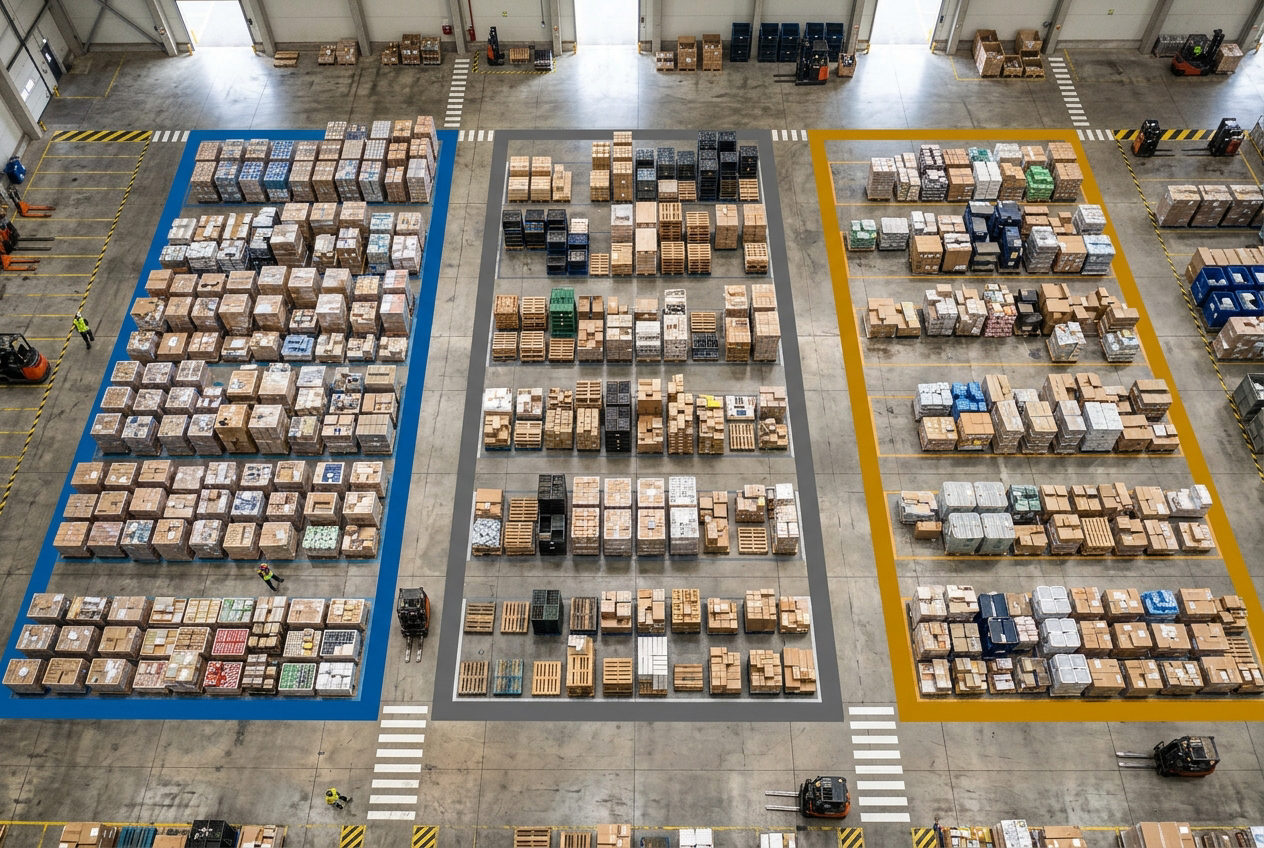
One warehouse floor seen from above, its stock split into separate zones by blue and amber floor lines

These terms are often confused. Each places inventory, ownership and cost in a different position.

ModelWho holds the stockWho owns it until useWho carries the capital
Traditional purchasingBuyerBuyerBuyer
VMIOften at buyer's site, replenished by supplierDepends on agreementDepends on agreement
ConsignmentBuyer's siteSupplier until consumedSupplier
Funded VMI (1TCC)1TCC-managed locations or buyer's site1TCC until consumed1TCC

Next step: ask for a comparison matrix for your category.

Email 1TCC about this

FAQ’sC. Procurement and supply chain

28 of 34

VMI for Global Manufacturing Supply Chains

Audience: OEMs

An automotive assembly line, car bodies moving between robotic welding stations

Global manufacturers manage complex networks: multiple plants, regions, suppliers and currencies, with long lead times and variable demand.

Challenges

  • Inventory held in many locations, with uneven visibility.
  • Long transit times and customs exposure.
  • Currency, tariff and logistics volatility.
  • Different ERP systems across plants and regions.

How VMI addresses them

  • A single program model across sites and regions.
  • Inventory positioned near plants to cut lead time.
  • Consistent data and reporting across locations.
  • Standard processes that reduce plant-by-plant variation.

Next step: request a multi-plant program design discussion.

Email 1TCC about this

D. Technology and AI

FAQ’sD. Technology and AI

29 of 34

How ERP Systems Enable Funded VMI Programs

Audience: CIOs

A long data center aisle between server racks with blue status lights and an amber glow at the far end

A funded VMI program depends on reliable, shared data. The ERP is its backbone.

What the ERP provides

  • Demand and forecast signals.
  • Material master data: items, specifications, units.
  • Purchase orders, receipts and consumption records.
  • Financial postings that track program activity.

What integration should deliver

  • Automated, near-real-time data exchange.
  • No manual re-keying or spreadsheet workarounds.
  • Clear audit trails from order to consumption.
  • Minimal changes to existing plant and finance processes.

Implementation considerations

  • Data quality and master data clean-up.
  • Security and access management.
  • Testing and phased go-live.

Next step: request an integration architecture overview.

Email 1TCC about this

FAQ’sD. Technology and AI

30 of 34

SAP and VMI Integration

Audience: SAP ecosystem

Network cables plugged into a rack switch with blue and amber lights, a busy factory floor behind it

Many of the world's largest manufacturers run SAP. Any VMI program that serves them has to work within it.

Typical integration points

  • Material and vendor master data.
  • Purchase requisitions, orders and goods receipts.
  • Consumption postings and stock transfers.
  • Invoicing and payment processes.
  • Reporting on stock by location and status.

Design principles

  • Use standard interfaces where possible.
  • Keep the customer's core processes intact.
  • Make the program transparent in SAP reports.
  • Support testing, controls and auditability.

Next step: SAP teams and implementation partners can request the technical integration guide.

Email 1TCC about this

FAQ’sD. Technology and AI

31 of 34

AI-Driven Inventory Optimization

Audience: CIOs, COOs

Two people's hands over a tablet showing a glowing network of nodes, warehouse racking blurred behind

Artificial intelligence can improve inventory decisions, but only when it is built on good data and clear objectives.

Where AI helps

  • Demand forecasting using more signals than history alone.
  • Setting safety stock and reorder points dynamically.
  • Spotting anomalies such as unusual consumption or quality issues.
  • Recommending actions: reorder, rebalance or review.

What it needs

  • Clean, consistent data across systems.
  • Clear service-level and cost objectives.
  • Human oversight of recommendations.
  • Measurement against a baseline.

Next step: request a demonstration of 1TCC's analytics.

Email 1TCC about this

FAQ’sD. Technology and AI

32 of 34

Data Visibility in Funded VMI Programs

Audience: CFOs, operations

Two operators seen from behind in a dim control room, facing a wall of dashboard screens

A funded VMI program should be easier to see into than the stock it replaces. Visibility is what builds trust.

What finance wants to see

  • Quantities and values held for the program.
  • Consumption and usage against forecast.
  • Aging and slow-moving items.
  • Cost and payment activity.

What operations wants to see

  • Stock by location and status.
  • Inbound orders and expected arrival.
  • Service levels, shortages and exceptions.

How it is delivered

  • ERP-integrated feeds and shared dashboards.
  • Regular reports on a set schedule.
  • Alerts when thresholds are crossed.
  • Audit trails that tie every movement to a record.

Next step: request a sample dashboard walkthrough.

Email 1TCC about this

FAQ’sD. Technology and AI

33 of 34

Inventory Traceability and Auditability

Audience: Partners, auditors

Blue-gloved hands holding a small precision-machined part in a clean lab

Auditors and partners want evidence. They need to confirm that inventory exists, where it is, and how it moved.

What traceability means

  • Each item is identified by lot, batch or serial number where needed.
  • Location, condition and movement are recorded.
  • Records link orders, receipts, holdings and consumption.

What auditability needs

  • Complete, time-stamped transaction history.
  • Reconciliation between systems and physical counts.
  • Access controls and change logs.
  • Documentation that supports independent review.

Next step: request 1TCC's controls and audit overview.

Email 1TCC about this

FAQ’sD. Technology and AI

34 of 34

The Future of AI in Procurement and Inventory Management

Audience: Industry thought leadership

An automated distribution centre at night, racked inventory and conveyor lines in deep blue light

Procurement and inventory management are becoming more automated, more connected and more predictive.

Trends to watch

  • AI agents that monitor demand and supply and take routine actions within set limits.
  • Autonomous sourcing of standard items, with people focused on strategy and supplier relationships.
  • Predictive risk signals on suppliers, logistics and prices.
  • Connected data across ERP, supplier systems and logistics providers.
  • Faster procurement cycles from request to order to payment.

What will not change

  • The need for trusted suppliers and clear accountability.
  • The value of good data and strong controls.
  • The importance of human judgment on strategic decisions.

Next step: follow 1TCC's research and join the conversation on the future of procurement.

Email 1TCC about this
Three senior executives reviewing printed charts together at a boardroom table

Don’t just optimize working capital - activate it.

1TCC enables companies to accelerate growth by unlocking capital from their supply chain. Explore how your inventory can support your next strategic initiative.

Request a demo